
When a warehouse employee is cleared to return after a shoulder injury. The phrase “return to work” does not answer the question an HR manager actually faces: can this employee safely lift. Carry, reach, and work at the pace the position requires? A fit for duty physical Tampa employers request connects a focused medical assessment to the essential demands of a specific job. For Tampa Bay organizations, that can support more consistent decisions without turning a workplace exam into a general physical.
Schedule an employer-specific fit-for-duty physical with Med A Physical.
A fit-for-duty physical evaluates whether an employee can safely perform defined essential job functions. The clinician reviews the employer’s job-demand description, relevant health information, and appropriate functional measures. The resulting opinion should address work ability and restrictions, not disclose an employee’s full medical history.
This guide is educational and does not replace legal advice, an individualized medical assessment, or an employer’s own policies. Exam scope and timing should be reviewed for consistency with applicable law and the specific workplace situation.
What is a fit for duty physical Tampa employers request?
A fit-for-duty physical is a job-focused medical evaluation. Its purpose is to answer a narrow operational question: can the employee perform the essential functions of the position safely, with or without stated restrictions? It is not a broad search for health conditions, and it should not be used to collect medical information unrelated to the job.
The useful part of the process is the connection between the exam and the actual work. A generic note that says an employee is “cleared” may offer little guidance to a safety manager. A job-specific referral can instead describe demands such as lifting 40 pounds from floor to waist. Climbing fixed ladders, wearing a respirator, driving for extended periods, or working in heat.
Possible outcomes of an evaluation
Depending on the referral question and findings, an occupational health clinician may report that the employee can perform the described duties. The opinion may instead state relevant restrictions, request more information, or recommend reassessment later. The employer then applies that opinion within its policies and applicable requirements. Med A Physical’s employer-specific physical exam service is designed around the duties supplied by the employer.
How it differs from other employment exams
A fit-for-duty evaluation usually concerns a current employee and a defined question about present work ability. A general employment physical may support a broader hiring or workplace-health process. A DOT physical, by contrast, follows federal qualification standards for commercial drivers. Employers should choose the exam that matches the role and the applicable program.
When might a Tampa Bay employer request an exam?
The right trigger depends on the role, the facts, company policy, and applicable law. Employers should avoid automatic, one-size-fits-all referrals. The strongest referrals begin with an objective, job-related reason and ask a focused question.
Return after injury, illness, or leave
A referral may be appropriate when an employee returns after a condition that could affect essential duties. Consider a Port Tampa Bay logistics employee whose role requires repetitive climbing and handling cargo. Or a construction employee in Citrus Park who must carry tools across uneven surfaces. In either case, a detailed description of the work is more useful than a job title alone.
The evaluation can help clarify whether temporary restrictions are relevant to the described work. It does not guarantee that an injury will not recur, and it does not replace the employer’s process for reviewing restrictions or accommodations.
Observed difficulty with essential tasks
An employer may also have a specific concern based on objective observations, such as repeated difficulty completing a safety-critical movement. The referral should document what was observed without diagnosing the employee. For example, “employee could not maintain the required ladder position during two assigned inspections” is more useful and neutral than speculating about a medical cause.
Transfer to a materially different role
A new assignment can introduce substantially different demands. Moving from dispatch to loading, from office work to field inspections, or from local delivery to a regulated commercial-driving role may require a different assessment. Tampa employers managing commercial drivers should review the separate requirements for DOT medical certification rather than treating it as a standard fit-for-duty exam.
Contact Med A Physical to discuss which occupational exam fits the role and referral question.
How should an employer prepare a job-demand description?
A job-demand description is the foundation of a useful fit-for-duty evaluation. It translates an internal job description into observable physical and environmental requirements. Without it, a clinician may have to make assumptions that do not reflect the worksite.
Describe essential functions, not every task
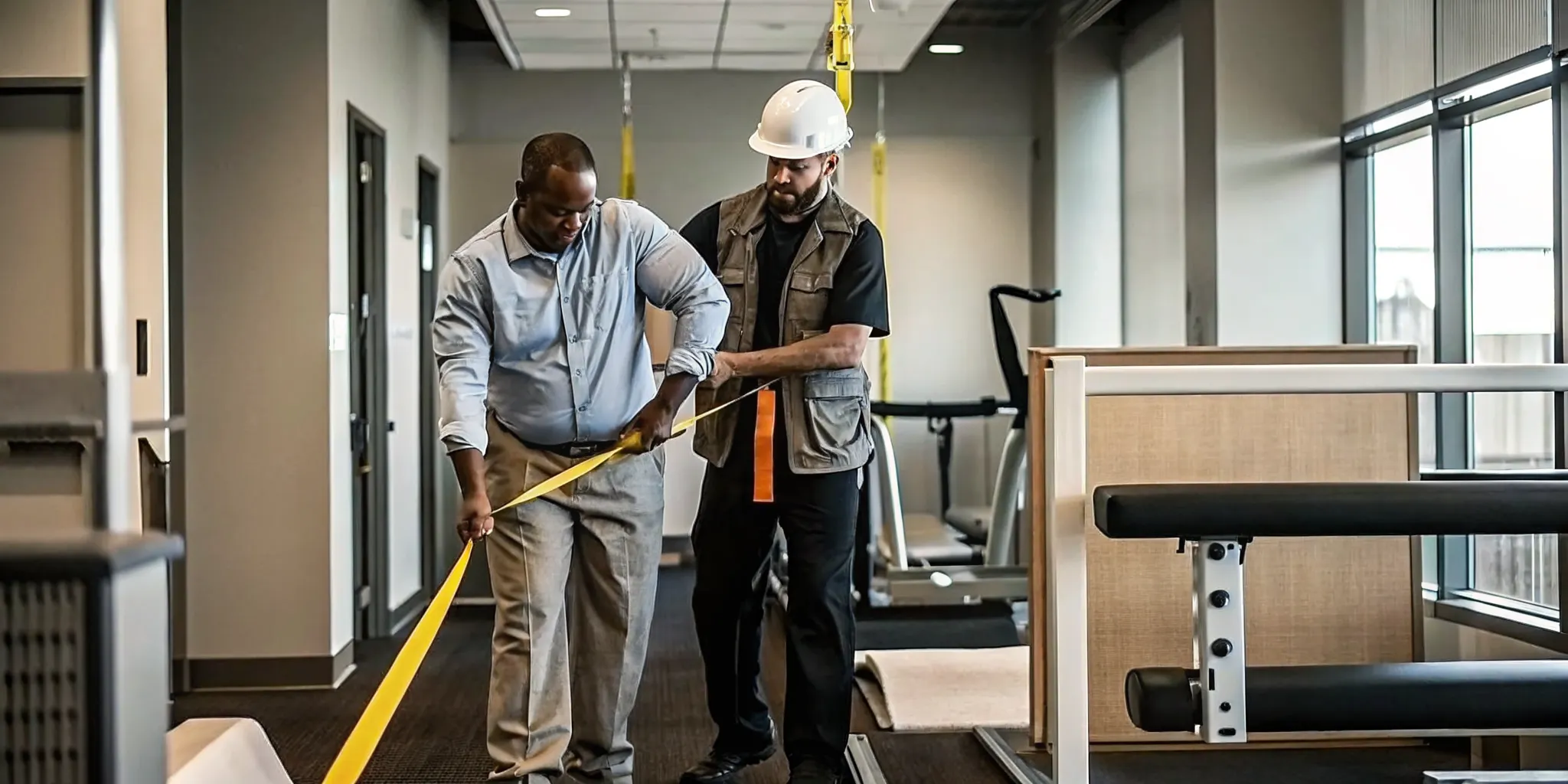
Start with the functions that are fundamental to the position. Separate them from occasional or easily reassigned tasks. For each essential function, state the movement, load, frequency, duration. And conditions involved. “Material handling” is vague. “Lift a 35-pound container from floor to a 36-inch platform up to eight times per hour” gives the clinician a usable demand.
Include environmental and safety-critical demands
Physical effort is only part of the picture. Note whether the employee works at heights, around moving equipment, in extreme heat, in confined spaces, or while wearing protective equipment. If the role involves respiratory protection or a regulated exposure program, an employer may need a more specific service, such as asbestos and lead physicals or other workplace surveillance.
Use a practical referral checklist
- State the employee’s job title and work location.
- List essential functions and explain why they are essential.
- Quantify lifting, carrying, pushing, pulling, climbing, reaching, or driving.
- Note environmental exposures and required protective equipment.
- Document the objective reason for the referral.
- Ask the specific work-ability question the clinician should address.
- Provide an employer contact for clarification.
For multi-site organizations, a standardized form can improve consistency while still allowing site-specific details. A warehouse in Town N Country may have different lift heights and walking surfaces than a field operation in Lutz. Med A Physical can also discuss on-site physical options when an employer needs a coordinated program.
What happens during a fit-for-duty evaluation?
The scope should match the referral question. An occupational health clinician generally reviews the job demands, relevant history, current symptoms or limitations, and any available records. The clinician may then use focused examination components or functional measures that relate to the essential work.
A job-related clinical review
The evaluation may consider strength, range of motion, balance, mobility, cardiovascular response, or another relevant function. It should not become an unrelated comprehensive exam. The specific components depend on the role, the concern, and the clinician’s judgment.
Communication of work ability
The employer typically needs a concise occupational opinion, such as whether the described duties can be performed and whether restrictions apply. HR and safety teams generally do not need an employee’s diagnosis or full medical record to act on that opinion. Keeping the referral and response focused helps protect privacy and gives decision-makers clearer information.
Follow-up when the answer is not yet clear
Sometimes the clinician needs records, clarification of job demands, or reassessment after a defined interval. That is a useful result, not a failed exam. It signals that the available information is not enough for a responsible opinion. Employers can reduce delays by sending a complete job-demand description and a reliable contact person with the initial referral.
Fit-for-duty, general, and regulated exams compared
Choosing the correct exam avoids unnecessary testing and improves the usefulness of the result. The table below summarizes common distinctions. Exact requirements vary, so employers should confirm the appropriate pathway for each situation.
| Exam type | Primary purpose | Typical input | Typical output |
|---|---|---|---|
| Fit-for-duty physical | Assess present ability to perform defined essential functions | Job demands and focused referral question | Work-ability opinion and relevant restrictions |
| General employment physical | Support an employer’s established screening process | Role information and exam protocol | Result based on the requested protocol |
| DOT physical | Determine qualification under applicable FMCSA medical standards | Federal forms, history, and required examination | Certification decision under the DOT process |
| Medical surveillance exam | Address a defined occupational exposure or standard | Exposure and program requirements | Program-specific medical opinion |
Med A Physical provides a range of employment physical services for Tampa Bay organizations. Employers that also coordinate screening programs can review employment screening services, including drug and alcohol testing.
Build a defensible and consistent referral process
A sound process is consistent, limited to job-related needs, and documented. It should define who can initiate a referral, what information is provided, how results are handled, and who reviews restrictions. HR, safety, operations, and legal advisers may all have a role in developing the process.
Keep the question narrow
Ask whether the employee can perform specified essential functions, not whether the employee is broadly “healthy.” Avoid requesting diagnoses or unrelated medical details. The U.S. Equal Employment Opportunity Commission provides employer guidance on disability-related inquiries and medical examinations; employers should consult qualified counsel for situation-specific legal advice.
Apply the process consistently
Comparable situations should follow comparable steps. A written referral template, trained decision-makers, and a defined review path can reduce ad hoc decisions. Consistency does not mean ignoring individual facts. It means applying the same decision framework while considering the actual role and referral reason.
Plan for restrictions before the result arrives
Decide who will assess restrictions and possible next steps. Supervisors should understand that the clinician supplies a medical work-ability opinion, while the employer makes employment and operational decisions. When an organization needs coordinated care at its location, Med A Physical’s on-site employment physicals may help streamline logistics.
Request an employer-specific physical exam for your Tampa Bay workforce.
Frequently asked questions
Is a fit-for-duty physical the same as a return-to-work note?
No. A return-to-work note may offer a general status, while a fit-for-duty evaluation addresses the employee’s ability to perform defined essential job functions. The value of the evaluation depends heavily on the employer’s job-demand description and focused referral question.
Can an employer ask for an employee’s diagnosis?
Employers generally should focus on work ability and relevant restrictions rather than requesting a full diagnosis or medical history. Medical inquiries and exams must be handled carefully under applicable requirements. Employers should seek legal advice for their specific circumstances.
How long does a fit-for-duty physical take?
Timing varies with the scope of the exam, available records, and whether the clinician needs clarification. A complete referral can reduce avoidable delays. Contact the clinic to discuss scheduling and the information needed for a specific evaluation.
Can Med A Physical evaluate a custom job-demand form?
Employers can provide their own job-demand description or exam protocol for review. The clinic can clarify whether the requested evaluation is appropriate and what additional information may be needed. Start with the employer-specific physical exams page.
Prepare a clearer fit-for-duty referral
A useful referral begins before the appointment. Define the essential job functions, quantify the demands, document the objective reason for the request, and ask a narrow work-ability question. That preparation gives the clinician better information and gives your Tampa Bay HR or safety team a more actionable opinion.
Med A Physical serves employers across Tampa, Town N Country, Westchase, Carrollwood, Citrus Park, Lutz, Odessa, and surrounding communities. Contact Med A Physical to discuss an employer-specific fit-for-duty evaluation.